A buyer tours a 60,000 sq. ft. strip mall. The listing says “rooftop HVAC, regularly maintained.” It is 24°C outside, the units are comfortable and nobody goes up on the roof. Eighteen months after closing, a rooftop unit fails in the middle of a heat wave. The refrigeration technician confirms that it runs on R-22, that the compressor is not worth repairing and that five other units from the same batch are the same age.
This scenario is common because rooftop units cannot be seen from the parking lot and are rarely documented in sales listings. Yet on a building with ten or twenty of them, their replacement ranks among the largest capital budget items, alongside the roof itself. Before making an offer, the real question is not whether the units work, but how much rooftop unit lifespan remains, what replacement will cost and when those expenses will hit.
What is an HVAC rooftop unit (RTU)?
A rooftop unit, or RTU, is a self-contained appliance that provides cooling, heating and ventilation for a zone from a single cabinet. It sits on a curb fastened to the structure and connects to ducts that pass through the roof. RTUs are found in retail buildings, low-rise offices, clinics, schools and warehouses with office space.
The refrigeration circuit includes one or more compressors, the condenser coil, the evaporator coil, the expansion valve and the refrigerant piping. The compressor is the most expensive component: on an older unit, a compressor failure often tips the decision toward full replacement.
The coils, made of copper and aluminum, are exposed to the weather, road salt, kitchen exhaust and industrial contaminants. Corrosion reduces their capacity and eventually causes leaks.
The heating section in Québec is most often a natural gas burner with a tubular heat exchanger. Other units use electric elements or operate as heat pumps with backup heat. The gas heat exchanger is a safety component: a crack can let combustion products mix with the supply air.
The economizer is a set of outdoor air, return air and exhaust dampers driven by an actuator and a sensor. It provides free cooling with fresh outdoor air. When it is seized or disconnected, which is common, that benefit is lost.
The controls, from the thermostat to the building automation system, determine how far the system can be optimized. Finally, the cabinet, the condensate pan and the curb often reveal the unit’s true age and level of maintenance.
Why rooftop units weigh heavily in the capital budget
The first factor is the fleet effect. Units are usually installed in a single batch, either at construction or during a renovation. They are the same age, use the same refrigerant and face the same conditions. When the first one declines, the others follow within a few years. Twelve units are not twelve small, independent risks, but one large risk concentrated in time.
The second factor is the true cost, which goes well beyond the price of the equipment: crane, curb adapter if the footprint differs, flashing repairs, gas and electrical connections, commissioning, permits and refrigerant recovery. Mobilizing a crane is costly for a single unit, which is why grouping replacements makes sense.
The third factor is contractual. Depending on the leases, replacement may be a landlord expense, a recoverable expense or a tenant obligation. You need to know which before you can price your risk.
Rooftop unit lifespan: what the references say
The most frequently cited reference is the ASHRAE table of median service lives (HVAC Applications handbook), which assigns rooftop units roughly 15 years. That figure comes from a statistical study conducted in the 1970s, and ASHRAE acknowledges that changes in technology and maintenance practices call its validity into question. It therefore maintains a public service life database fed by real buildings, which can be filtered by equipment and building type, while noting that submitted data is not verified. It is a benchmarking tool, not a guarantee.
A median means that half the units in a sample were replaced before that age; it is not an expiry date. A well-maintained unit can last more than 20 years, while a neglected one can be finished at 10 or 12.
Factors that extend or shorten service life
Environment: a salted highway, an industrial area or a commercial kitchen hood all accelerate corrosion. On restaurant roofs, grease-fouled coils are common.
Maintenance: filters, coil cleaning, belts, connections, burners and leak tests. A complete maintenance record is one of the best predictors of remaining service life.
Sizing: an oversized unit short-cycles, which wears out the compressor and controls humidity poorly; an undersized unit runs nonstop. Changes in use, such as a warehouse converted into a clinic, are a classic cause.
Age is not enough: remaining service life
The estimate combines expected service life, actual or “effective” age and observed condition. A 12-year-old R-22 unit with a corroded coil and no maintenance record may have an effective age of 17 years. A 16-year-old unit maintained under contract, with a replaced compressor, may have several years left. This documented judgment is what separates a technical inspection from simply reading nameplates.
R-22 in commercial buildings and the HFC phase-down: the refrigerant issue
The refrigerant now determines a unit’s economic life as much as the condition of its components.
R-22 (HCFC-22): a technology at the end of the road
R-22 depletes the ozone layer. Since January 1, 2020, federal regulation SOR/2016-137 has prohibited the import or manufacture in Canada of any product that contains, or is designed to contain, an HCFC. The supply of new HCFC has been cut to a residual quantity reserved for servicing, until the complete phase-out scheduled for 2030 under the Montreal Protocol. In Québec, the Regulation respecting halocarbons (Q-2, r. 29) also prohibits installing commercial air conditioning equipment designed for an HCFC or modifying equipment so that it runs on an HCFC.
In practical terms, an R-22 unit can operate legally, but every leak or failure in the refrigeration circuit becomes a difficult decision: R-22 is scarce and expensive, and after 2030 servicing will depend on recovered and reclaimed refrigerant. Converting to a drop-in blend usually costs capacity and is rarely justified on older equipment. In an acquisition budget, an R-22 unit should be treated as a short-term replacement, whatever its apparent condition.
R-410A and the HFC phase-down
R-410A, which replaced R-22, does not deplete the ozone layer, but it is an HFC with a high global warming potential (GWP of about 2,000). Under the Kigali Amendment, Canada is reducing its consumption of new HFCs in steps relative to its baseline: 10% since 2019, 40% since January 1, 2024, 70% as of January 1, 2029 and 85% in 2036. R-410A equipment is not becoming illegal, but the refrigerant needed to service it will be increasingly restricted.
The federal regulation also bans certain new products: since January 1, 2025, the manufacture and import of chillers using a refrigerant with a GWP above 750 has been prohibited, a ban that the Québec regulation applies to sale and installation. However, at the time of writing, Canadian regulations set no GWP limit specific to packaged rooftop units. In 2024, Environment and Climate Change Canada launched a review that considers extending controls to other air conditioning and heating equipment, partly to align with the United States.
The market shift to R-454B and R-32
In the United States, since January 1, 2025, the Environmental Protection Agency has prohibited the manufacture and import of most new residential and light commercial air conditioning and heat pump systems using a refrigerant with a GWP of 700 or more. Because the market is integrated, major manufacturers have converted their rooftop unit lines to R-454B (GWP of about 470) and R-32 (GWP of 675).
These refrigerants are classified A2L, or mildly flammable, which brings installation requirements (CSA B52 standard) and specific technician training. For the buyer, this means that a replacement today involves a new-generation unit whose footprint, weight and connections may differ, and that a recent R-410A fleet can be planned normally, but with refrigeration servicing costs that are set to rise.
The Québec obligations the buyer inherits
| Obligation (Regulation respecting halocarbons) | What it means for the buyer |
|---|---|
| Leak test at least once a year (no more than 15 months apart) for air conditioning equipment of 20 kW or more | Maintenance contract that includes these tests and proof of them |
| New test between the 30th and 60th day after a leak repair | Check for these follow-ups in the service history |
| Leaks must be stopped without delay; for 20 kW or more, recovery and assessment of the quantity released within 48 hours | A chronically leaking unit is a regulatory liability |
| Label showing the refrigerant, the charge and the date of the last modification | A missing label signals poor follow-up |
| Work restricted to qualified technicians, who keep a record and give the owner a copy | The seller should be able to provide these copies |
Unit-by-unit inventory method
Reading the nameplate
The nameplate shows the manufacturer, model, serial number, electrical supply, refrigerant type and charge and, for gas units, the burner input. The model number often encodes capacity in thousands of Btu/h: a “120” segment typically means 120,000 Btu/h, or 10 tons. The convention does, however, vary between manufacturers.
Decoding age from the serial number
For most manufacturers, the date of manufacture is encoded in the serial number (year and week, year and month, or a letter assigned to a year). The format has changed several times even within the same manufacturer, which leads to frequent misreadings; when in doubt, the manufacturer can confirm the date. Three cautions: the manufacture date is not the installation date; a repainted unit can look new; and a replaced compressor makes the refrigeration circuit younger, not the rest of the unit.
Sample inventory table
| No. | Year | Capacity | Heating | Refrigerant | Economizer | Observed condition | History | Remaining life | Priority |
|---|---|---|---|---|---|---|---|---|---|
| RTU-01 | 2007 | 10 tons | Gas | R-22 | Seized | Corroded coil, oil traces | Partial | 0 to 2 years | P2 |
| RTU-02 | 2007 | 10 tons | Gas | R-22 | None | Out of service (compressor) | None | None | P1 |
| RTU-07 | 2012 | 7.5 tons | Gas | R-410A | Working | Good, worn belt | Complete | 5 to 8 years | P3 |
| RTU-12 | 2023 | 5 tons | Heat pump | R-454B | Working | Very good | Warranty | 15+ years | Maintenance |
Each unit is numbered on a roof plan, photographed and linked to the zone it serves. This table often reveals that a fleet presented as “maintained” combines a few recent units, replaced after breakdowns, with a majority of original units.
Documents to request from the seller
Maintenance contracts and reports for the last three years, copies of halocarbon service records, invoices for compressor or unit replacements, transferable warranties, mechanical drawings and comfort complaints logged by the property manager.
HVAC inspection before buying a building: what to check
A pre-purchase inspection does not replace a full performance test by a refrigeration technician, but it covers what drives the decision. On each unit, depending on access, season and safety:
Cabinet: corrosion of the casing and rails, missing panels, water in the electrical compartment.
Refrigeration circuit: oil traces at fittings, a common sign of a leak; insulation; compressor noise and vibration; presence of the regulatory label.
Coils: crushed fins, fouling, corrosion, insufficient clearances that cause hot air to recirculate.
Gas heating: flame, corrosion of visible tubes, draft, venting, gas piping and supports. Any doubt about the heat exchanger warrants a specialized examination, because it affects occupant safety.
Ventilation and economizer: belts, bearings, filters, damper and actuator movement, sensor.
Electrical: disconnect switch, conduits, connections. The thermal camera, included in every one of our inspections, picks up connections that are running abnormally hot.
Condensate: perforated pan, blocked trap, drainage onto the membrane.
Tests: cooling in summer (temperature difference between return and supply air), heating in winter. A compressor should never be forced to run in cold weather; in that case the report must state what was not verified, and the budget must account for it.
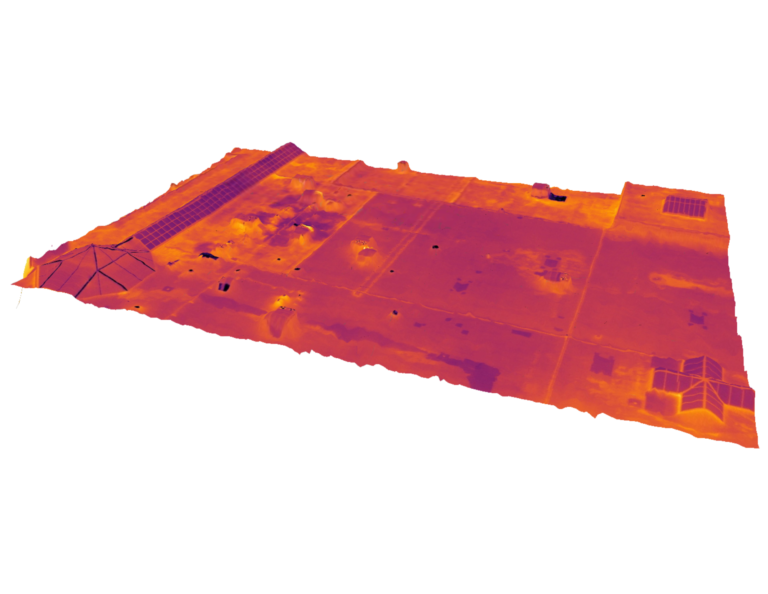
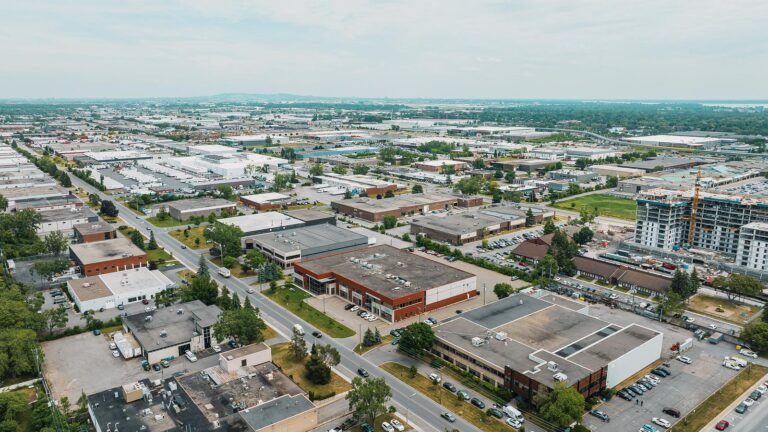
The drone survey, also included, makes it possible to count the units, identify those that have been replaced and document water pooling around the curbs.
The roof interface: where unexpected costs hide
This is the most underestimated issue, and the one where a building engineer who looks at the envelope, the roof and the mechanical systems together adds the most value.
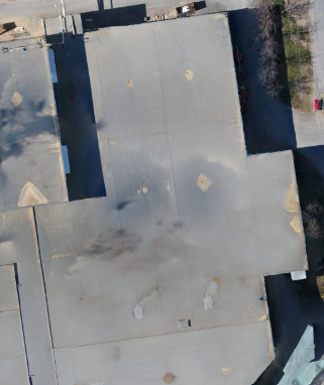 Visible view
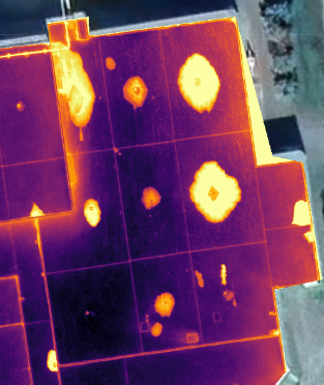 Infrared view
Curbs and flashing. Every curb passes through the membrane and the insulation. Loose flashing around a curb can let water in for years without any sign inside.
Trapped moisture. A roof infrared thermography survey carried out under the right conditions reveals wet insulation, often concentrated around equipment. These areas will have to be replaced when the roof is redone.
Weight and structure. A new-generation unit may be heavier or require an adapter that changes how loads are distributed. On a light steel structure, load-bearing capacity must be checked. Equipment also creates snow drifts that must be taken into account.
Coordination with the reroofing. If the membrane needs to be replaced in three years and half the units reach end of life at the same time, the work should be coordinated: remove the units, rebuild the curbs and upstands, then install the new units with a single crane mobilization. Replacing units two years after a reroofing means opening a brand-new membrane and can compromise its warranty. Our article on commercial flat roof lifespan helps place the roof in its life cycle, and a roof assessment pins down the reroofing date.
Energy impact and opportunities for improvement
A planned replacement, rather than an emergency one, makes it possible to reduce energy use for the next fifteen to twenty years.
Efficiency ratings. For commercial units of 65,000 Btu/h (about 5.4 tons) and up, cooling efficiency is measured by IEER, a weighted rating that reflects part-load operation, where the unit spends most of its time. Smaller units are rated by SEER2. Between a 2007 unit and current equipment with a multi-stage or variable-speed compressor, the difference in seasonal efficiency can be significant.
Rooftop heat pumps. Including cold-climate models, they shift part of the heating load from gas to electricity, which in Québec is mostly renewable. The choice between a heat pump alone, a heat pump with backup and conventional gas depends on the building’s electrical capacity, utility rates and heating needs during extreme cold. Electrical service capacity must be checked early, because upgrading it can be expensive.
Economizers, ventilation and controls. Repairing or recalibrating economizers is often one of the most cost-effective measures for an RTU fleet. CO2-based demand-controlled ventilation, realistic scheduling and monitoring that detects neighbouring units heating and cooling at the same time all deliver savings without replacing equipment.
Energy audit. For a fleet of several units, an energy audit and modelling compares replacement scenarios based on actual consumption and documents incentive applications. Our article energy audit in Québec: where to start outlines the steps. Hydro-Québec (Efficient Solutions program) and Énergir offer energy efficiency programs for business customers; measures, amounts and conditions change regularly, and some require an application before purchase. Eligibility must be checked at the planning stage, not afterwards.
Worked example: 12 rooftop units and their 10-year budget
This example is illustrative; its cost assumptions are detailed below.
The building. Strip mall of about 60,000 sq. ft., flat roof, four tenants.
| Lot | Quantity | Capacity | Year | Refrigerant | Condition summary |
|---|---|---|---|---|---|
| A | 6 | 10 tons | 2007 | R-22 | One out of service, two with signs of leaks, coil corrosion |
| B | 3 | 7.5 tons | 2012 | R-410A | Good condition, documented maintenance |
| C | 2 | 15 tons | 2019 | R-410A | Very good condition |
| D | 1 | 5 tons | 2023 | R-454B | Replaced after a breakdown, under warranty |
Infrared thermography reveals wet insulation around four of the lot A curbs, and the roof assessment places the reroofing three to four years out.
Assumptions for the example. Amounts are illustrative orders of magnitude in 2026 Canadian dollars, before taxes, and not Québec market prices. For each replacement, they include the new unit, the crane, a curb adapter if the footprint changes, gas, electrical and duct connections, recovery of the old unit’s refrigerant and commissioning. They exclude reroofing, structural modifications and major electrical upgrades. Depending on capacity, we use about $25,000 for a 7.5-ton unit, $40,000 for 10 tons and $60,000 for 15 tons, plus an allowance of $5,000 per year for unplanned repairs. For comparison, Canadian contractors publish ranges of the same order, which rise sharply with capacity. For a real decision, only quotes for the specific equipment are reliable.
| Period | Work | Priority | Illustrative cost |
|---|---|---|---|
| Year 0 | Replace the out-of-service A unit | P1 | $40,000 |
| Years 1 to 2 | Replace the two leaking A units | P2 | $80,000 |
| Year 3 | Last three A units, coordinated with the reroofing | P3 | $120,000 |
| Years 7 to 8 | Three lot B units (about 21 years old) | P3 | $75,000 |
| Years 1 to 10 | Repair allowance | P3 | $50,000 |
| Total (before taxes) | $365,000 |
The 15-ton units will be 17 years old at the end of the horizon; a 25-year table, if the lender requires one, will need to include them.
What the example shows. Nearly two-thirds of the budget ($240,000) falls in the first three years, because of the R-22 lot. A buyer who relied on the 15-year median and the fleet’s “working” appearance would have underestimated the immediate risk. Grouping the last A units with the reroofing avoids opening a new membrane and reduces crane mobilizations. An alternative is to replace all six A units in a single campaign in year two: similar direct cost, earlier energy savings, but a concentrated cash outlay. The right choice depends on the buyer’s cash position and what can be negotiated on price.
Using these findings in negotiation and financing
In negotiation
A costed inventory turns an impression into a verifiable argument. P1 expenses (unit out of service, active leak) are generally negotiated directly: price reduction, credit at closing or replacement by the seller. P2 expenses are often negotiated through a partial reduction or a holdback. P3 expenses are used to validate the price against the expected return. If the inspection takes place in January, cooling tests are impossible: it is reasonable to negotiate a more conservative allowance or an in-season test. Our article on pre-purchase inspection to protect, negotiate and finance expands on these strategies.
In financing
Commercial lenders increasingly require a commercial building condition assessment (BCA) or a PCA under ASTM E2018: a visual, non-destructive site visit, document review and interviews, with HVAC systems explicitly covered and costs presented as immediate needs and projected replacements.
At Boreon, findings are classified as P1 (immediate), P2 (short term, one to two years) and P3 (planning), in a capital expenditure table that usually covers 10 years, or 25 years if the lender requires it. A well-documented rooftop unit inventory feeds directly into this table and into the replacement reserve the lender may impose. See our article on PCAs and the ASTM E2018 standard, our building condition assessment approach and our page for brokers, insurers and lenders.
Common mistakes
Relying on the sales listing. “HVAC maintained” says nothing about age, refrigerant or condition. Only an inventory on the roof does.
Applying the 15-year median to the whole fleet. An R-22 unit is budgeted on its economic life, not its theoretical life.
Confusing “works” with “in good condition.” A unit that starts up may have a compressor near the end of its life or a cracked heat exchanger.
Forgetting related costs. Crane, adapter, roof repairs, structural reinforcement, electrical upgrade for a heat pump.
Planning the roof and HVAC separately. This is the most expensive mistake: it forces you to tear open a new membrane or rebuild the curbs twice.
Ignoring leases and regulatory records. Without knowing who pays, or having the refrigeration history, you will misprice your risk.
Checklist before the purchase offer
- Request the equipment list, maintenance contracts and reports, and halocarbon service records as soon as the promise to purchase is signed.
- Arrange safe access to the roof and to tenant spaces.
- Record every nameplate: model, serial number, capacity, refrigerant, heating.
- Date each unit and identify replaced compressors or units.
- Classify all R-22 units, at a minimum, as short-term replacements.
- Note any tests not performed because of the season.
- Assess curbs, flashing, insulation moisture, structure and the reroofing date.
- Check electrical capacity if heat pumps are being considered.
- Read the leases to find out who pays for replacement.
- Turn the inventory into a P1, P2, P3 prioritized table for negotiation and financing.
FAQ on HVAC rooftop units
What is the lifespan of an HVAC rooftop unit?
The ASHRAE table gives a median service life of about 15 years, but that figure comes from an old study and is not a deadline. Depending on maintenance, environment and sizing, a unit can last anywhere from 10 to more than 20 years. A reliable estimate combines age, observed condition and refrigerant.
How can you tell the age of a rooftop unit?
The date of manufacture is usually encoded in the serial number on the nameplate, in a format specific to each manufacturer and period. Some nameplates show it directly, and the manufacturer can confirm it. The installation date may be somewhat later.
Is an R-22 rooftop unit illegal in Québec?
No, an existing R-22 unit can continue to operate. However, installing new commercial equipment designed for an HCFC, or converting equipment to one, is prohibited, and the supply of new R-22 ends in 2030. In practice, an R-22 unit that suffers a major leak or a compressor failure is generally replaced.
Should R-410A rooftop units be replaced?
Not necessarily: R-410A remains permitted in existing equipment in Canada. The HFC phase-down will, however, limit the supply of new refrigerant, and manufacturers have moved to R-454B or R-32 for their new product lines. An R-410A fleet in good condition can be planned normally, with rising refrigeration servicing costs.
How much does it cost to replace a commercial rooftop unit?
The cost depends on capacity, heating type, roof access and related work such as the crane, curb adapter and flashing repairs. For a typical-size unit, the installed cost runs into the tens of thousands of dollars. Making a decision requires a precise inventory and contractor quotes.
Does a commercial pre-purchase inspection cover rooftop units?
It should. A thorough commercial pre-purchase inspection inventories each unit, assesses its condition and its interface with the roof, then translates the findings into priorities and costs. It also indicates where a performance test by a refrigeration technician is warranted.
Do lenders require an assessment of HVAC equipment?
Many commercial lenders require a property condition report under ASTM E2018, which covers HVAC systems and presents immediate costs and projected replacements. A documented rooftop unit inventory makes that report more accurate and simplifies the discussion around the replacement reserve.
Conclusion: buy knowing your roof, and what sits on it
Rooftop units cannot be seen from the parking lot, but they do show up in the financial statements. A unit-by-unit inventory, linked to the condition of the roof and translated into a capital expenditure table, gives the buyer leverage to negotiate, the lender a clear reading of the risk and the property manager a realistic plan.
Boreon performs pre-purchase inspections of commercial and industrial buildings, building condition assessments under ASTM E2018 and roof assessments across Québec, with infrared thermography and drone surveys included in every inspection. As an independent firm, Boreon sells neither repairs nor construction work. For a building you are considering acquiring, request a quote for a commercial pre-purchase inspection.
Sources
- ASHRAE, Service Life and Maintenance Cost Database: costdatabase.ashrae.org
- Justice Canada, Ozone-depleting Substances and Halocarbon Alternatives Regulations (SOR/2016-137): laws-lois.justice.gc.ca
- Environment and Climate Change Canada, Consultation document: review of the Ozone-depleting Substances and Halocarbon Alternatives Regulations (2024): www.canada.ca
- LégisQuébec, Regulation respecting halocarbons (Q-2, r. 29): www.legisquebec.gouv.qc.ca
- ASTM International, E2018-24 Standard Guide for Property Condition Assessments: www.astm.org
- U.S. Environmental Protection Agency, Technology Transitions Program: www.epa.gov