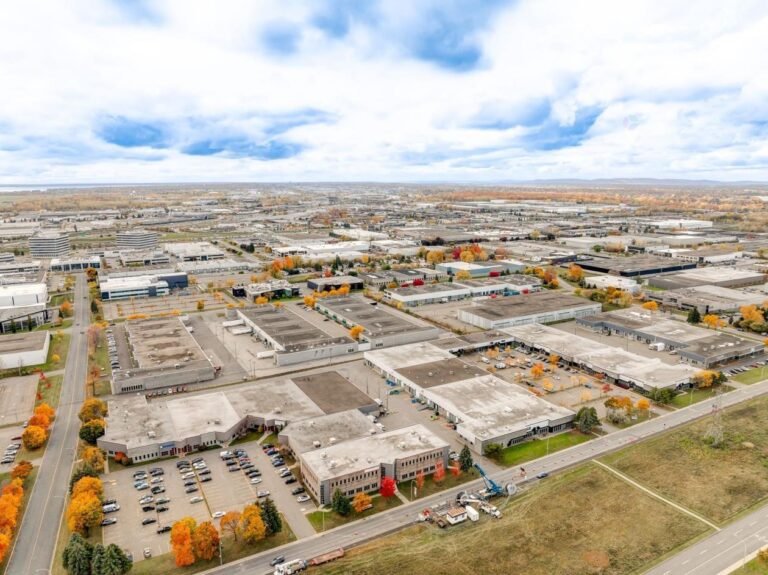
Building: commercial · Area: West Island of Montreal · Roof: mechanically fastened TPO membrane, 3 sections of about 7,000 sq ft each · Services: pre-purchase building condition assessment (BCA), then roof assessment with thermography
The context
A buyer was in the process of acquiring a commercial building in the West Island of Montreal. Boreon was retained to carry out the pre-purchase building condition assessment (BCA).
According to the seller, the roof had already been repaired, and only one section had never been replaced. At 18 years old, it still had, in his words, “time left”.
The first findings
During the inspection, the roof quickly caught our attention, especially the membrane. It was a TPO (thermoplastic polyolefin) membrane, a white single-ply membrane mechanically fastened to the deck. There were numerous past repairs, and the membrane formed waves in several places, particularly around the repairs.
Why repairs and waves on a TPO membrane are a concern
The sheets of a TPO membrane are joined by hot-air welding. These seams are its weak point: their quality depends on temperature, cleanliness and the installer’s skill. Over the years, the membrane surface weathers in the sun, and a repair weld bonds to it less well. It must be cleaned, sometimes abraded, and the repair remains less reliable than the original membrane.
Waves are another clue. A mechanically fastened TPO membrane is held only at the rows of fasteners, along the seams. If the fasteners are too far apart, poorly installed, or if a repair was not properly tensioned, the membrane wrinkles and forms waves. These wrinkles work with every hot-cold cycle, stress the nearby welds and can hold water.
A TPO roof covered with repairs and waves is therefore not a “repaired” roof: it is often the sign of a membrane accumulating leaks. Boreon shared its concerns with the buyer, who agreed to a more in-depth roof assessment.
The in-depth assessment
- Thermographic survey of all 3 sections, in the evening, to locate areas where the insulation holds water.
- Moisture meter readings to confirm moisture in the insulation and map the affected areas.
- Calculation of the area of wet insulation relative to the total roof area.
Why confirm thermography with a moisture meter
Thermography locates suspect areas over the whole roof in a single evening. But in a transaction, a number has to be solid. Moisture readings confirm each area and quantify the true extent of the problem. This is what the reference practice, ASTM C1153, recommends: verify infrared anomalies with direct methods.
The findings
The picture quickly became clear: the entire roof was subject to water infiltration, not just the 18-year-old section. Moisture readings confirmed that about 57% of the area had wet insulation.
Why water spread over more than half the roof
- A membrane that is not adhered. Between the rows of fasteners, the membrane rests loosely on the insulation. When water enters through a failed weld or repair, nothing stops it: it travels under the membrane and wets the insulation far beyond the entry point.
- A membrane that “breathes”. In strong winds, a mechanically fastened membrane lifts and drops between fasteners. This movement can draw humid indoor air into the insulation, where it condenses in cold weather. The poorer the fastening, the stronger the effect.
- Leaks that add up. Every repair that fails adds a new water entry point, often unnoticed until water comes through the ceiling.
In other words, on this type of roof, a small unrepaired leak quickly becomes a major insulation problem.
The impact on the transaction
With more than half the insulation wet, repairs were no longer an option: the roof had to be replaced in the short term, with removal of the membrane and wet insulation. Typical ranges in Greater Montreal, before taxes:
| Work | Approximate cost | For about 21,000 sq ft |
|---|---|---|
| Full replacement (removal of membrane and insulation, new system) | $18 to $28/sq ft | ≈ $380,000 to $590,000 |
| Spot repairs on an aged TPO membrane | Variable | Does not address the wet insulation |
For a buyer, that is a major expense that appeared nowhere in the picture presented by the seller. The terms of the transaction were revised accordingly, before signing, not after the first leak.
The result
The buyer completed the transaction taking the roof’s actual condition into account, with a detailed, quantified report in hand. The same report also serves the lender and the insurer, who value knowing the condition of this component precisely.
Why the roof is so often overlooked when buying
In a transaction, people look at the financials, the leases, the mechanical systems. The roof is often judged at a glance, or based on what the seller says. Yet on a one- or two-storey commercial building, it is often the most expensive component to replace, and its most serious defects, such as wet insulation, are invisible from the surface.
And the stakes go beyond the cost of the roof. A leak can damage equipment, stop a production line and, in the pharmaceutical, medical or food industries, jeopardize a certification: contamination of a controlled area, product recall, full shutdown pending the certifying body’s inspection. For the buyer, but also for the lender and the insurer, knowing the roof’s actual condition before signing is a matter of risk management.
A roof assessment with thermography, added to the pre-purchase BCA, costs a fraction of what it can save.
Key takeaways
- A roof’s age does not tell the whole story: actual condition, and above all moisture in the insulation, is what matters.
- On an aged TPO membrane, numerous repairs and waves are warning signs.
- A mechanically fastened membrane lets water spread far from the entry point.
- Before buying a commercial building, have the roof assessed with thermography and moisture readings. It is a major financial variable.
Frequently asked questions
Should the roof be inspected before buying a commercial building?
Yes. On a one- or two-storey commercial building, the roof is often the most expensive component to replace. A visual inspection is not always enough: a roof assessment with thermography and moisture readings reveals wet insulation, invisible from the surface, so it can be reflected in the price or the terms of the transaction.
Is an 18-year-old TPO membrane at the end of its life?
Age alone cannot tell you. What matters is the actual condition: quality of the welded seams, number of repairs, wrinkles and waves in the membrane, and above all, water in the insulation. In this case, 57% of the insulation was wet.
Can a TPO membrane be repaired?
Yes, by hot-air welding a patch of new membrane. But on an aged membrane, the surface deteriorates and the weld holds less well: it must be cleaned, sometimes abraded, and the result remains less reliable. A TPO roof covered in repairs is a warning sign that should be assessed.
Why do lenders and insurers care about the condition of the roof?
Because the roof protects the entire building and everything in it: equipment, inventory and, in an industrial building, production itself. In some industries (pharmaceutical, medical, food), a leak can contaminate a controlled area, jeopardize a certification, trigger a product recall or a full shutdown pending an inspection by the certifying body. A detailed report, with thermography and the percentage of wet insulation, allows the lender and insurer to assess these risks and the short-term spending required.
Learn more: building condition assessment · roof inspection and expertise · another case study: industrial roof in Saint-Laurent
Assess a building before buying
Real case presented anonymously. Some details have been generalized to protect the client’s confidentiality. Costs are indicative ranges, not a quote.