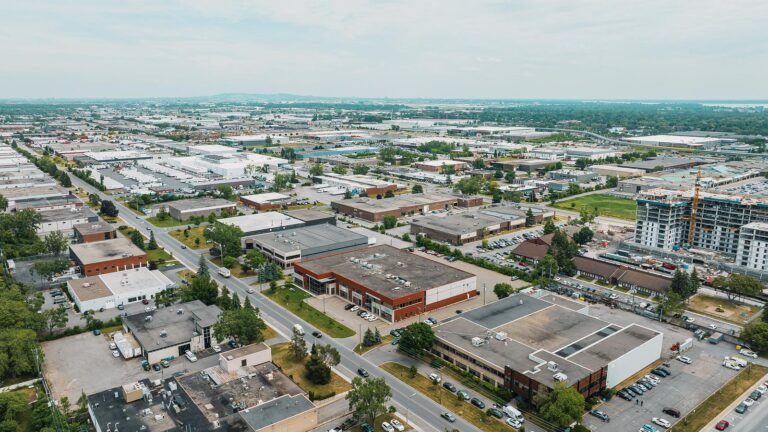
Building: industrial, single storey, large footprint · Area: Saint-Laurent (Montreal) · Roof: 10-year-old modified bitumen (SBS) membrane, 4 sections of about 6,000 sq ft each · Service: roof assessment with thermography
The context
The owner of an industrial building in Saint-Laurent was facing two problems he believed were unrelated. First, his electricity and gas bills had risen sharply over three years. He suspected his rooftop mechanical units. Second, for a few months, some units had been leaking during heavy rain.
His fear: a roof that was completely finished and had to be redone entirely, even though it was only 10 years old. On a single-storey building, the roof covers the entire footprint. It is the largest part of the building envelope, the most expensive to replace, and a leak can shut down operations in the affected areas.
The assignment
- Thermographic survey of all 4 roof sections, in the evening after a sunny day.
- Daytime verification of each anomaly, to confirm water in the roof system.
- Mapping and measurement of the affected areas, to define a precise scope of work.
- Inspection of the rooftop mechanical units, since they were the client’s first suspect.
Why roof thermography is done in the evening
During the day, the sun heats the whole roof. In the evening, it cools down. Wet insulation contains water, which holds heat much longer than the air trapped in dry insulation. Wet areas therefore stay warmer and stand out clearly on the infrared camera. The extent of the problem is not guessed: it is seen. This is the method described in ASTM C1153, the reference practice for locating wet insulation in roofing systems with infrared imaging.
The findings
The thermography revealed three significant thermal anomalies. The rest of the roof appeared sound. The daytime check confirmed that all three areas were wet right into the insulation, which was saturated with water.
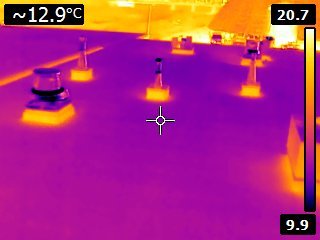
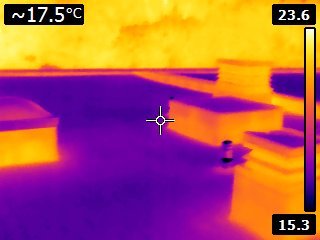
This finding explained both problems at once: water accumulating in the insulation eventually leaked into the units during heavy rain, and wet insulation barely insulates at all.
The mechanical units, on the other hand, were in good condition, sparing the client unnecessary spending there. On the affected sections, the membrane also had too many critical defects to be simply repaired.
Why wet insulation drives energy bills up
Insulation works because it traps air or gas, which conducts heat very poorly. When water replaces that air, everything changes: water conducts heat about 20 times better than air. The thermal resistance of the area drops, and the building loses heat through the roof in winter and gains it in summer.
The loss depends on the type of insulation. Fibrous insulations (mineral wool, fibreboard) can lose more than half of their thermal resistance when wet. Rigid foam insulations hold up better, but a saturated board is still a board that no longer insulates properly, and it almost never dries under a watertight membrane.
Trapped water also causes other damage: it adds weight, freezes and thaws, blisters the membrane above and can rust the steel deck below. The longer you wait, the larger the affected area becomes.
The recommendation
- Replace the insulation only in the affected areas, as measured in the survey.
- Re-cover (new membrane) only the affected sections, where the membrane had too many critical defects.
- Leave in place the sound section, which still had many years of service left.
Since the affected sections needed new insulation and a new membrane anyway, it was the right time to improve the roof’s performance. The client made two choices: polyisocyanurate insulation and a light-coloured, high-SRI membrane.
Why polyisocyanurate insulation
Thermal resistance is expressed as an R-value: the higher it is, the better the material insulates. Approximate values per inch of thickness, when dry (see also Natural Resources Canada’s guide Keeping the Heat In):
| Insulation | Approx. R-value per inch | Good to know |
|---|---|---|
| Polyisocyanurate (polyiso) | R-5.5 to R-6 | Highest performance for a given thickness. Its performance drops in extreme cold, which is accounted for in the thickness. |
| Extruded polystyrene (XPS) | R-5 | Handles moisture well. Used notably in inverted (protected membrane) roofs. |
| Expanded polystyrene (EPS) | R-3.6 to R-4.2 | Economical, but needs more thickness. |
| Mineral wool (board) | R-3.7 to R-4.2 | Non-combustible, but sensitive to water. |
| Fibreboard or perlite | R-2.5 to R-2.8 | Often used as a cover board, low insulating value. |
For the same thickness, polyisocyanurate offers the best insulating value among common roof insulations. By replacing the wet insulation with polyiso, the redone areas now insulate better than the original.
Why a light membrane: the Solar Reflectance Index (SRI)
SRI measures a surface’s ability to stay cool in the sun. It combines two properties: the share of solar radiation reflected, and the surface’s ability to release the heat it absorbs. The scale runs from 0 (a standard black surface) to 100 (a standard white surface), following the Cool Roof Rating Council method (ASTM E1980). Some white membranes even exceed 100.
Why it matters:
- Less heat in the building in summer. A dark membrane can exceed 70 °C in full sun. A light, high-SRI membrane stays much cooler, which reduces air-conditioning loads.
- A membrane that ages more slowly. Less heat and daily expansion means less stress on the membrane.
- Less urban heat island effect around the building, a major issue in heavily paved industrial areas.
- It is often mandatory. In Montreal, redoing a flat roof generally requires a white or reflective covering, or an SRI of at least 66. Some boroughs require more (at least 78 in Rosemont–La Petite-Patrie). Always check with your borough.
In winter, the loss of solar heat due to a light roof is small: the sun is low, days are short and the roof is often covered with snow.
Full replacement or targeted work: the cost difference
Typical ranges observed in Greater Montreal for a commercial or industrial modified bitumen roof, before taxes. Prices vary with access, deck condition, flashings, drains and the required insulation thickness.
| Work | Approximate cost | What it includes |
|---|---|---|
| Full replacement | $18 to $28/sq ft | Tear-off down to the deck, new insulation, new two-ply membrane, flashings |
| Re-cover | $8 to $14/sq ft | Preparation of the existing surface and installation of a new membrane, insulation kept |
| Localized insulation replacement | + $4 to $8/sq ft (affected area) | Opening, removal of wet insulation, new insulation, waterproofing repair |
Applied to this building:
- Replacing the whole roof (4 sections, about 24,000 sq ft): in the range of $430,000 to $670,000.
- What was done: re-cover of 3 sections (about 18,000 sq ft), in the range of $145,000 to $250,000, plus insulation replacement in the 3 wet areas only.
Even with the insulation, the targeted work costs roughly half the price of a full replacement, sometimes less. The 4th section, which was sound, was left as is. And the redone sections perform better than before.
The result
One year after the work: no more leaks, and energy consumption lower than before the problems started, thanks to dry, higher-performance insulation combined with a reflective membrane.
Key takeaways
- Rising energy bills and leaks can have a single cause: wet roof insulation.
- A leaking roof does not necessarily need a full replacement. Thermography maps what is actually affected.
- On a single-storey building, the roof is the most critical part of the envelope. Having it assessed before deciding can avoid hundreds of thousands of dollars of unnecessary work.
- When redoing a roof, the membrane colour (SRI) and the insulation choice affect your energy costs for the next 20 to 30 years.
Another case study
Another case: before buying a commercial building in the West Island, 57% wet insulation found under a TPO membrane. Read the case study →
Frequently asked questions
How much does it cost to redo a commercial flat roof per square foot?
For a modified bitumen (SBS) membrane in Greater Montreal, expect roughly $18 to $28/sq ft for a full replacement (tear-off, insulation, two-ply membrane) and roughly $8 to $14/sq ft for a re-cover that keeps the existing insulation. Prices vary with access, deck condition and details such as flashings and drains.
Does wet roof insulation need to be replaced?
Yes. Water-saturated insulation loses a large part of its thermal resistance and practically never dries under a watertight membrane. It keeps damaging the roof system. It should be replaced, but only in the areas that are actually wet, which thermography can map.
What is the Solar Reflectance Index (SRI) of a roof?
SRI measures how well a surface stays cool in the sun, on a scale from 0 (black) to 100 (white). A light membrane with a high SRI reduces heat entering the building in summer, slows membrane ageing and is often required in Montreal when a flat roof is redone.
Can roof thermography avoid a full roof replacement?
Often, yes. By precisely locating wet insulation, it limits the work to the affected areas and sections. In this case, 3 of 4 roof sections were re-covered and only the insulation in the wet areas was replaced, for roughly half the cost of a full replacement.
Learn more: roof inspection and expertise · thermography
Real case presented anonymously. Some details have been generalized to protect the client’s confidentiality. Costs are indicative ranges, not a quote.