Under the concrete slab of the basement and garage in most Quebec homes lies a layer of crushed-stone backfill. In some cases, that stone contains pyrite, a mineral that can make the backfill swell and lift the slab. Here is how to recognize the signs, how the test works and what it changes when you buy.
What is pyrite and why does it make backfill swell?
Pyrite is an iron sulphide (FeS2) common in certain rocks, especially black shales. In contact with moisture and oxygen, it oxidizes and produces sulphuric acid. The released sulphates react with the calcium in the rock and form gypsum, which takes up roughly twice the volume of the original pyrite. The result: the backfill expands and pushes the slab upward.
The presence of pyrite does not automatically cause damage. Backfill thickness, rock type and mechanical strength all play an important role. That is why only a laboratory assessment can reach a conclusion. Damage generally becomes noticeable about ten years after construction.
Where is the problem found in Quebec?
The first cases of swelling backfill were documented in Montreal in 1985, and the Comité technique québécois studying pyrite-related swelling problems was created in 1997. It can affect any building whose under-slab backfill comes from pyrite-bearing rock; only a laboratory test can confirm it, regardless of the area.
Pyrite vs. pyrrhotite: don’t confuse them
| Pyrite | Pyrrhotite | |
|---|---|---|
| Where? | In the granular backfill under the slab | In the aggregate of the foundation concrete |
| Effect | Backfill swelling, slab heaving and cracking | Cracking of the concrete walls and slabs |
| Associated regions | Greater Montreal | Mauricie and Centre-du-Québec (buildings built between 1996 and 2008) |
| Typical fix | Replacing the backfill and slab | Replacing the foundations |
A seller who says a house “has no pyrrhotite” tells you nothing about the backfill under the slab, and vice versa.
Warning signs
- Star- or cross-shaped cracks in the basement or garage slab, sometimes with one side of the crack higher than the other.
- Whitish powder (sulphates) along the cracks.
- A domed slab: the centre of the room is higher than the edges.
- Doors that rub or stick in the basement, cracked or distorted partitions, baseboards pulling away.
- Near-vertical cracks in foundation walls and, in advanced cases, a wall pushed outward.
Note: each of these signs can have another cause (concrete shrinkage, settlement, frost). A finished basement can also hide the slab.
What a visual inspection can see, and what requires a lab
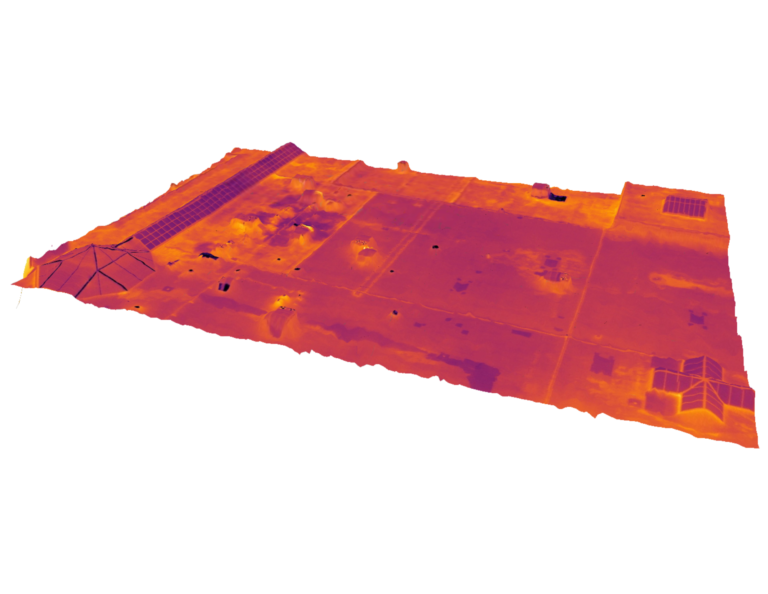
During a pre-purchase inspection, our InterNACHI-certified inspectors examine the accessible surfaces of the basement and garage: slab cracks, height differences, partitions, door frames and foundation walls. Clues consistent with swelling backfill are photographed, located and described in the report. Thermography, included in every inspection, helps spot abnormal moisture in the basement, but it does not detect pyrite.
What a visual inspection cannot do: determine what the backfill is made of. Boreon does not perform pyrite testing or corrective work. When signs are observed, we recommend that the client hire a specialized laboratory or an engineer experienced in backfill before waiving conditions.
How does pyrite testing work?
Assessing an existing building (CTQ-M200 protocol)
For an existing home, the reference is the CTQ-M200 assessment protocol, which has three parts:
- Visual survey of slabs, partitions and foundation walls, with measurement of height differences.
- Sampling: coring the slab (minimum 150 mm diameter), usually once in the basement and once in the garage, and collecting the backfill over its full thickness.
- Laboratory testing: determining the IPPG (petrographic swelling potential index), followed, if needed, by chemical analyses (total sulphur, sulphates) and thin-section examination.
The IPPG is obtained by identifying, under a stereomicroscope, the different rock types (facies) that make up the backfill; each is assigned a value based on its swelling potential, and the weighted sum gives the index. Under the protocol, an IPPG of 10 or less with no damage to the building corresponds to a swelling potential considered negligible. Otherwise, interpretation is up to the professional. The protocol also states that the assessment should not be performed by a firm that could do the repair work or has an interest in the transaction.
Newer homes: DB-certified stone
The IPPG test method is standardized in BNQ 2560-500, and BNQ 2560-510 governs the characterization of aggregates at the production site (“DB” materials, for dalle de béton, or concrete slab) as well as document management through to the owner taking possession. Garantie de construction résidentielle (GCR) requires accredited contractors to use DB-certified crushed stone for under-slab backfill and to keep delivery slips showing the source and certification. For a recent home, these documents are the best proof to ask for.
Corrective work
When the backfill is confirmed to be problematic and work is recommended, the usual solution is to demolish the slab, excavate and remove the swelling backfill, replace it with DB-certified stone, then pour a new slab. The work is designed by an engineer and carried out by a specialized contractor holding the appropriate RBQ licence. Cost varies with floor area, access and finishes: only a contractor quote based on the assessment is reliable.
Financial and legal impact when buying
- Negotiation: an unfavourable assessment report lets you renegotiate the price, require work before the sale or withdraw under the conditions of the promise to purchase.
- Existing certificate or report: ask the seller for any CTQ-M200 report, IPPG result, DB stone certification or proof of work already done (with the invoice and the laboratory’s name).
- Seller’s declarations: check the section on pyrite and soil problems in the seller’s declarations. A known, concealed problem can open the door to a latent defect claim; however, an apparent sign that a prudent buyer should have noticed can weaken that claim, which is why an inspection matters.
- Warranty plan: for a new home, the RBQ points out that the guarantee ends five years after the work is completed and that filing a claim promptly is essential.
- Government assistance: the SHQ’s program for residences damaged by pyrrhotite ended on September 30, 2026, and it targeted foundations affected by pyrrhotite, not pyritic backfill. Do not count on a grant to pay for backfill work.
Buyer’s checklist
- Note the year of construction and ask whether a pyrite test or backfill work was ever done.
- Obtain the reports, the IPPG and the DB stone delivery slips, if they exist.
- Book a pre-purchase inspection and require access to the garage and unfinished areas.
- If signs are found, hire a laboratory or an engineer before waiving conditions.
- Consult a notary or lawyer if you have doubts about the seller’s declarations.
Frequently asked questions
Can an inspector confirm the presence of pyrite?
No. A visual inspection spots and documents consistent signs. Confirmation requires sampling and laboratory testing (IPPG and, if needed, chemical analyses).
Can a house with no cracks have pyrite?
Yes. Damage often takes about ten years to appear. Only an IPPG result is reliable.
Is a house that has already been repaired a good buy?
It can be, provided you obtain the assessment report, proof that the backfill was replaced with DB stone and the contractor’s invoices.
Is there still a grant?
The SHQ pyrrhotite program ended on September 30, 2026. Check with your municipality or the SHQ before making any decision.
Get an inspection before you commit
Boreon documents basement warning signs during every pre-purchase inspection and points you to the right specialists when needed. Request your pre-purchase inspection quote.
Sources
- Régie du bâtiment du Québec: Pyrite and pyrrhotite
- BNQ: standard BNQ 2560-500 (IPPG)
- BNQ: standard BNQ 2560-510 (DB materials)
- Quebec Ministry of Natural Resources: report ET 2003-02 on the IPPG (French)
- Groupe ABS: swelling problems associated with pyrite in granular backfill
- GCR: concrete and under-slab backfill quality requirements (French)
- Québec.ca: Program for residences damaged by pyrrhotite (French)